

A year of two realities
Exploring the two dimensions of before and after loss, reading Joan Didion & sharing two of my own peoms
Dear everyone,
Yesterday it was exactly one year since my father has passed. Damn, was I scared of that day. As if the whole thing would happen to me again.
Well, it didn’t.
But it showed me how much I am still struggeling to arrive in this new reality after the loss.
My system jumps between two dimensions, two timelines: the one before the loss and the one after.
Yesterday I was back there again, thinking I could avoid this loss somehow. Words poured out of me like tears. Words of resistance, of powerlessness.
Today I feel relief, gratitude and acceptance. I feel the gift that this experience has offered me and the new freedom it had brought me.
I want to use this moment to explore this duality. And to offer you two poems that I wrote during the time of his growing dementia, confusion & the nearing loss.
The time of dissolution.
I feel frightened and excited to finally get them out. I wrote them in German but I did my best to find an adequate translation to English (not sure that worked).
Grief is different. Grief has no distance. Grief comes in waves, paroxysms, sudden apprehensions that weaken the knees and blind the eyes and obliterate the dailiness of life.
- Joan Didion
There are days, when I’m still holding him. Like a baby in my arms. A heavy one. One that should have been put down long ago, let run freely and go its way.
My body believes that I can keep him alive if I keep strong and hold on tight.
If I’m like him.
I have seen him take his last breaths, the urn being buried, the cross on his grave.
But what does that mean? How can I know it’s really true?
He always came back. No matter how exhausted he was, how much he was carrying. He always returned to the house that he loved so much and that he didn’t want to leave in the end.
Joan Didion writes in her book The Year of Magical Thinking about resisting the reality of her husbands’s death:
I could not give away the rest of his shoes.
I stood there for a moment, then realized why: he would need shoes if he was to return.
The recognition of this thought by no means eradicated the thought.
I have still not tried to determine (say, by giving away the shoes) if the thought has lost its power.
Her words helped me to normalize this state of denial. It helped me to understand how I am trying to take power back, how I create the illusion that I have the power to reverse this whole thing.
The powerlessness towards the way of nature - in these moments I’m in war with it.
No one teaches you how to accept, how to surrender to this force. They teach you about math problems, how to do push ups and play the flute.
But they don’t teach you how to surrender to life.
(My poem from 2023 - English translation below)
Wir lösen uns auf
Weißt du noch
wie du als Einjähriger
über die Lonske-Düne gekrochen bist?
Und wir hinterher -
weißt du noch?
Und ich als Ensemblesprecher
meine Rede gegen den Oberbürgermeister -
da waren sie alle baff.
Weißt du noch?
Dein leerer Blick am Abend,
zitternd stehst du vor dem Bett,
und fragst: „Wann passiert hier endlich was?“
Niemand fängt dich auf.
Wir vier in Griechenland -
die Wellen schäumen,
und du fährst uns übers Meer.
Weißt du noch?
Dir läuft jetzt ständig die Nase,
und du verwechselst unsere Namen.
Dinge gehen verloren.
Wir lösen uns auf.
Du auf meinen Schultern,
mit deinem blonden Schopf,
Hoch St. Paul.
Weißt du noch?
Ich habe Angst vor der Nacht,
und am Tag wart’ ich auf die Tränen.
Ich würde mich so gern anlehnen,
an deinen breiten Schultern.
Gesichter aus kleinen Steinen auf der Fensterbank,
an der Wand Bilder von Chaos.
Du sagst, du kannst nicht mehr malen -
welche Farbe hat Angst?
Weißt du noch,
als wir alle dachten du stirbst,
und du darüber gelacht hast?
Du sagst, da ist nichts zum Festhalten.
Die Welt da draußen ist dir fremd;
du sprichst ihre Sprache nicht mehr,
und sie vergisst dich langsam.
Wohin mit dem Groll?
Weißt du noch,
wie wir alle unsere Rolle kannten
und ständig lachten -
wie niemand den Fall fürchtete?
Weißt du noch?
Jemand hat dir dein Kostüm genommen.
Du bekommst nur noch Nebenrollen.
Die Souffleuse ist längst in Pension,
und das Theater bald geschlossen.
Wir lösen uns auf.
We’re Fading
Do you remember
how, as a one-year-old,
you crawled over the Lonske Dune?
And we ran behind you -
do you remember?
And me, the ensemble speaker,
speaking up against the mayor—
you should have seen their faces.
Do you remember?
That empty look in your eyes at dusk,
you trembling by the bedside,
asking, “When is it finally happening?”
No one’s there to hold you.
The four of us together in Greece -
waves frothing,
and you taking us over the sea.
Do you remember?
Now your nose is always running,
and you mix up our names.
Things disappear.
We’re fading.
There you are, perched on my shoulders,
your blonde tuft catching the light,
ascendant St. Paul.
Do you remember?
I fear the night,
and by day I wait for the tears.
Oh, how I long to lean
against your strong, broad shoulders.
Tiny faces made of pebbles on the windowsill,
and on the wall: images of chaos.
You say you can no longer paint -
of what color is fear?
Do you remember
when we all thought you would die,
and you laughed in the face of it?
You say there is nothing to hold onto.
The world out there has become foreign to you;
you no longer speak its language,
and slowly, it forgets you.
Where to with all that resentment?
Do you remember
when we all knew our parts
and laughter filled the air—
when no one feared the fall?
Do you remember?
Someone stripped you of your costume.
Now you’re left with only minor roles.
The prompter has long since retired,
and the play is nearing its end.
We’re fading.
I didn’t keep his shoes. They are way too big for me anyway.
But I’m trying to keep him alive in my own ways.
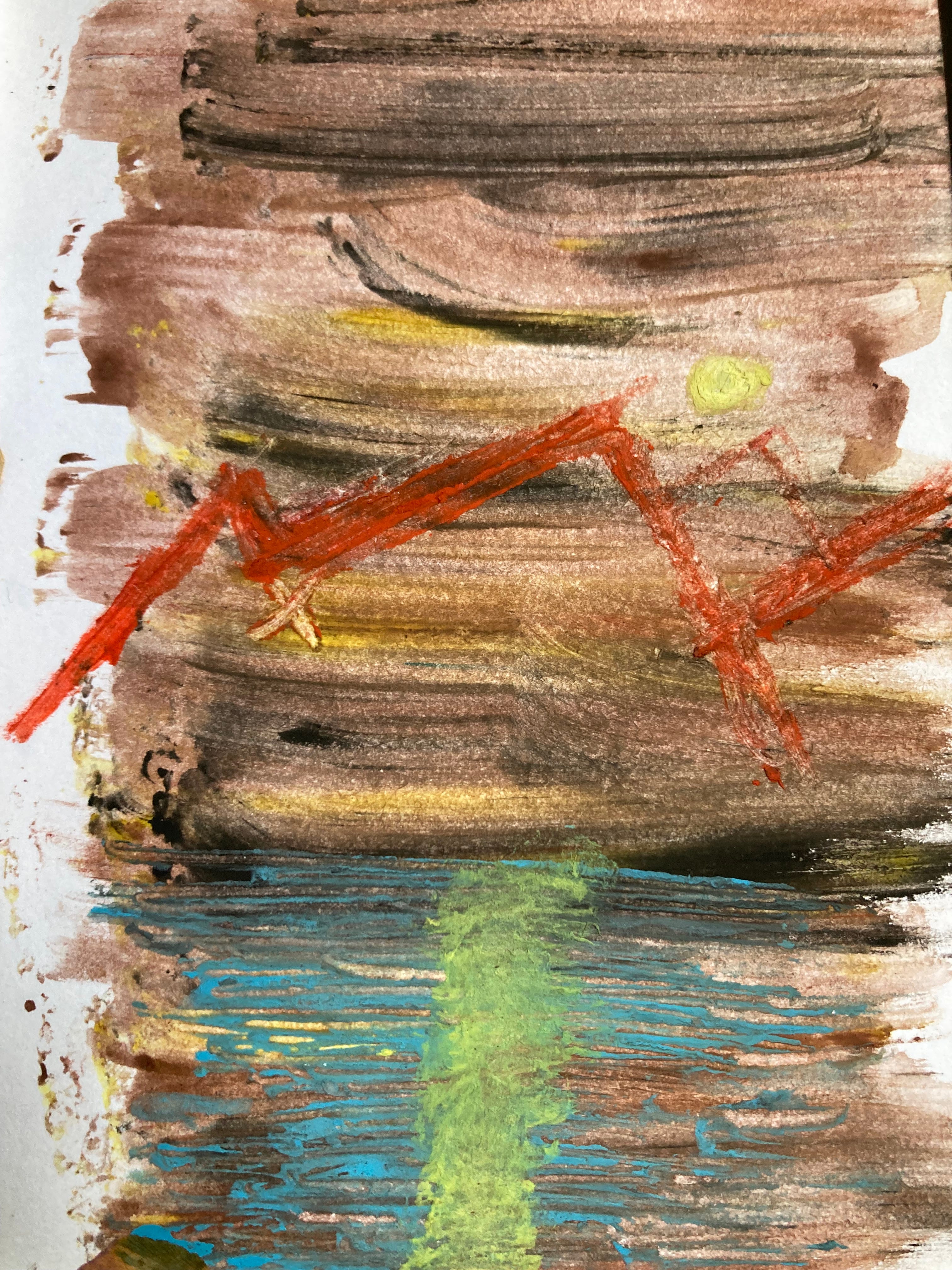
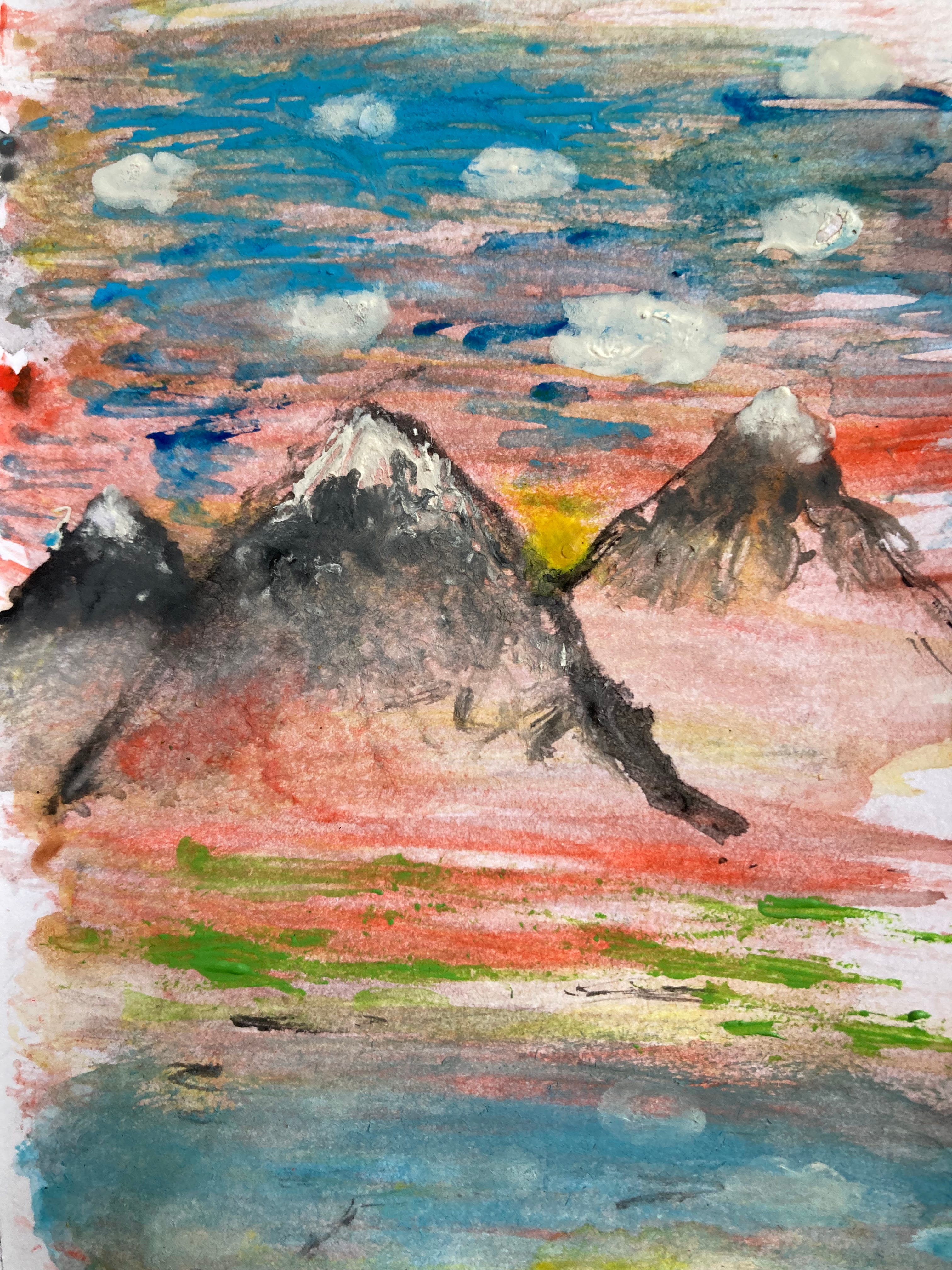
I started painting, with his little black case of aquarell colours, that has paint all over, mixed colours prepared for the little postcards he used to send to everyone.
I imagine these colours to show me how to paint with his guidance, his supervision but without his judgement. What comes out is new, it’s mine but we share the same source.
I’m not painting for him, for his recognition.
Now I’m painting with him.
One year and so much has happened. But my body still speaks the same language. The heaviness on the chest, the tightness in my shoulders, neck and throat.
Sometimes I ask myself: Will it ever disappear? Will I ever feel light again?
Yes, there are plenty moments when I accept that he is not here anymore, not here on this earth.
When I start something new, I risk something, I take responsibility, I let myself step on unknown territory, ride a wave with the possibility to fail.
Because there is no father to disappoint.
When I enter a conflict, shaking, afraid but determined.
Because I know there is no father that will come and defend me.
When I take care of myself, treat myself like a loving child.
Because there is no father to make happy, to take care of.
When I take the stage to sing, to play guitar, to speak my truth.
Because there is no father that will feel threatened.
And when I feel. When I cry, sing and laugh.
Because there is no father that would feel helpless, left out or run away.
These are precious moments - full of playfulness and power.
I can see the shy child that once felt so small next to his father, powerless and unable to show himself, to make himself heard next to this ever present, loud and charismatic father that always needed to be in the center of attention.
And yet, there are moments where I try to protect him like have done for so long - especially when he started to feel weaker, forgetful and absent.
When I want to leave the stage to him for his last, big performance.
When I prefer to stay quiet, so his voice remains louder.
When I suppress my feelings, not to trigger his.
When I believe I have to protect his shame and make it mine.
When I am afraid to go on a trip because something could happen to him when I’m not there.
(Poem from 2023 - English translation below)
Sprich, Vater
Fast verloren, fast vergessen,
starren seine Augen in die Ferne.
Vater, sprich, denk ich,
aber Schweigen legt sich über mich.
Seine Verzweiflung gefriert meine Sehnen,
erstarrt meine Wirbel.
Seine Trauer rauscht mir durch den Kopf,
die Scham zerfrisst meine Gedärme.
Und in meinem Gegenüber—
regt sich kein Hauch.
Speak, Father
Nearly lost, nearly forgotten,
his eyes fixed on the distance.
Father, speak, I think,
but silence folds around me.
His despair freezes my sinews,
locks my spine in place.
His sorrow rushes through my skull,
his shame devours my gut.
And in the one before me—
not a single flicker stirs.
Moving into the present and being constantly pulled back into the past.
These are the two dimensions that are alive inside of me.
I observe them wrestling in me like two people during a rope pulling game.
I am learning patience, acceptance. The understanding that our minds and bodies take often longer to adapt to the changes around us, changes that sometimes happened long ago.
This is how I’m slowly navigating this new reality.
Moment by moment, day by day, week by week.
Because what I know for sure is that he would want only one thing from me:
to live my life fully.
Or in Joan Didion’s words:
I know why we try to keep the dead alive: we try to keep them alive in order to keep them with us. I also know that if we are to live ourselves there comes a point at which we must relinquish the dead, let them go, keep them dead.
Thank you for bearing with me during this looooong ass newsletter as well as during the ups and downs of this year of two realities.
I’m super grateful!
And promise: in the next newsletter I will share a light short stories that will make you smile and wonder :)
Warmly,
Nima
If you enjoyed this text and want to support my work without becoming a paid subscriber, feel free to buy me a coffee. Thank you very much :)
This was so moving, the way you wove the past and present together, the push and pull of grief and becoming. What a powerful, tender way to keep your dad close while also becoming more fully yourself.
Das bewegt sehr viel, dabei habe ich so eine Situation selbst noch nicht erlebt. Aber die Reflektiertheit in deinen Worten bringt es mir nahe. Besonders erreicht haben mich die aufgezählten Momente, die, in denen der Weggang deines Vaters dich befreit hat, und ihnen gegenübergestellt die, in denen du deinem Bild von ihm noch zugewandt bist. Diese generelle Widersprüchlichkeit macht das Beschriebene auch sehr lebendig. Tut mir leid, wenn der Kommentar stellenweise wie eine Rezension klingt, denn das hat so ein Werk auf keinen Fall verdient, aber manchmal ist es schwer, das Innere in Worte zu fassen.
Ach ja, die Bilder gefallen mit auch sehr.
Herzlichen Dank,
Yara