
Father and son
A story about learning to give up being a journalist by reading about the life of a journalist legend and connecting with his son
He showed me why I wanted to be a journalist—and why I had to quit journalism to truly experience life.
To meet others.
And above all: to meet myself.
His books awakened a nostalgia for the old days, when journalists were the first witnesses—sometimes the only ones—the messengers, the deliverers of truth.
The journalist as an adventurer. A world narrator. A storyteller.
A time when texts were filed by telegram or dictated during costly overseas calls. When correspondents drank whiskey in hotel lobbies, waiting for informants to appear and lead them to the scene. When magazines devoted ten pages to a single story, immersing readers in worlds otherwise unreachable.
When the pursuit of truth resembled a treasure hunt.
A time that had long passed…
Tiziano Terzani—Italian journalist, foreign correspondent for Der Spiegel in Asia for more than thirty years.
A legend.
He reported on the war in Vietnam, Pol Pot’s Cambodia, and was among the first Western journalists admitted to China. He narrowly escaped death more than once. He smoked opium in hidden backrooms, met mafia bosses and warlords, endured arrest by Communists.
He witnessed the fall of the Soviet Union. He met the Dalai Lama. And once, he spent an entire year traveling without airplanes, simply because a fortune-teller had advised him not to fly.
His motivation was always peace. His texts depicted cruelty and despair, yet they remained manifestos of peace.

He belonged to a time when journalism still carried a mission. And he reminded me of the beauty of this profession with sentences like this:
Every place is a goldmine. You have only to give yourself time… the most insignificant place becomes a mirror of the world, a window on life, a theatre of humanity.
It was during my own crisis of journalism that I discovered him—drowning in endless investigations that seemed to have no impact, watching social media rise, fake news spread, research time shrink, headlines accelerate.
I asked myself: What for?

Terzani, facing periods of depression and finally stomach cancer after decades of succesful and award-winning journalism, asked the same. And like many, he finally came to this conclusion:
The real change must come from inside each of us. Only then can there be hope for a peaceful world.
Maybe it doesn’t have to take me so long, I thought.
Tiziano Terzani. What a name.
I first heard his name near Bologna, staying with friends. I wasn’t interested. I had left journalism behind. I didn’t want to dig into the dirt anymore. Except with my own hands; I preferred cutting wood, sweeping terraces, and going on walks with my new dog friend Nilo.
But they told me: he was more than a journalist. In his final years, he lived in the Himalayas, practicing meditation and studying different Eastern healing practices. Before his death, he returned to his family home in Orsigna. Pilgrims came to see him.
His son lives there now with his family, I was told. You can visit his house.
I didn't.
But when I returned to Berlin, the name lingered. One day, wandering through the city, I found his book, The End Is My Beginning, in a second-hand bookstore. Not a collection of reportages or diaries, but a dialogue with his son shortly before his death.
A final reckoning.
I read it in one sitting.
What struck me most was not the war stories or the adventures, but his vulnerability and openness towards his own son. The way he talked about facing death, the impermanence of life, and discovering peace within.
His acceptance touched me deeply.
At the same time, my father’s health was deteriorating. He denied everything—illness, mortality, even fear. And I longed for one honest conversation before it was too late. To still get to know him before he would pass.
To still have one truthful converstation.
One moment of looking each other in the eye without turning away.
One more breath

I’m looking at a body lying flat on the bed. Pale, wrinkled, swollen. I don’t know this body. I don’t want to know this body.
In Terzani's own farewell, he offered this invitation to presence across absence:
I'll be there. I'll be up in the air. So sometimes, if you want to talk to me, put yourself in a corner, close your eyes and look for me.
The book left me frustrated and impatient about the situation with my own father, yet clear about one thing: my journalist’s mask had to go. It had given me a feeling of superiority and power, protected me from vulnerability, but also from connection.
I had mastered stories, but lost intimacy.
In the end, that mask had led only to loneliness and disconnection.
I spent the winter of 2022 in Italy, reading more of his books, including excerpts from his diaries. I felt his discipline, his harsh self-criticism, his enormous ambitions that drove him forward.
He wrote openly about his family, about the separations during his reporting trips, and later during his chosen exile in the Himalayas. About his son, Folco, he sometimes wrote with pride, sometimes with incomprehension.
Between the lines, I sensed the high expectations he had for him. I couldn’t help but wonder what it must have felt like to stand in the shadow of such a man, who was always in the center of attention.
I drifted toward my own relationship with my father, who was a similar figure. A man from another century, it seems today. The charisma, the mastery of self-portrayal, the unshakable self-righteousness.
I knew it well. And I saw myself in Folco’s position: the feeling of never quite meeting a father’s expectations, of never reaching this mirror of perfection. The self-doubt and worthlessness that followed.
Perhaps it was projection. But I felt a connection to that son, who was often only mentioned in passing.
Friends told me that Folco still lived in the family house nearby. I learned he had written a book, volunteered at Mother Teresa's Home for the Dying in Kolkata, India, and later returned with his family to Orsigna.
When I saw his photo, I nearly fell off my chair. He looked almost exactly like my father in his youth—the dark hair, the bushy eyebrows, that striking nose. I was stunned.
It felt like finding an old photo of my dad.
I knew I had to meet this man. Not just because of his father, but because I wanted to know: How do you deal with such a father? How do you say goodbye? And even more importantly: how do you learn to live your own life with such a father—even after he’s gone?
Through a friend, I got his email and wrote to him, saying I was in the area and would love to meet. This time, everything felt different. I wasn’t writing as a journalist. It wasn’t an interview request. I had no prepared questions. I wasn’t even planning to publish anything.
I was writing as a son.
I felt shaky, insecure, vulnerable. I didn't know what he would think of a guy who didn't even know whether he would publish an interview. Who just wanted to meet up out of curiosity.
But it felt somehow liberating to be completely honest and open about my intentions. I could feel the mask drop. And showing myself.
I was ready for meeting someone with curiosity.
Not with an agenda.
He invited me for lunch the following week. Casually. Yet very kindly.
Nima
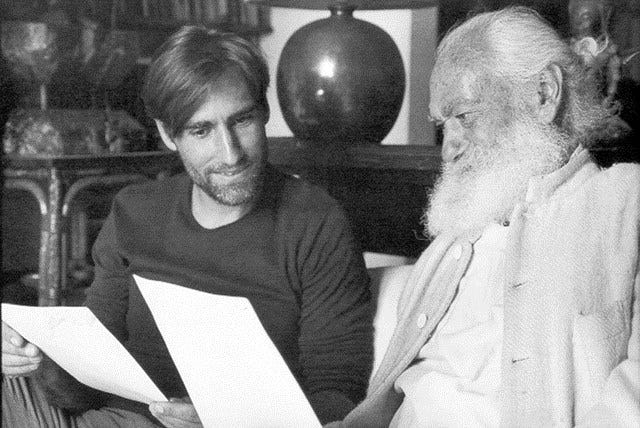
(Photo: Folco Terzani (left) with father, the Italian journalist Tiziano Terzani.)
Part 2—about my meeting with Folco—will follow in the next newsletter…
If you enjoyed this text and want to support my work without becoming a paid subscriber, feel free to buy me a coffee. Thank you very much :)
Very gripping :-) Wonderful description of the "old days". I totally get the appeal. And I'm really interested to read about that conversation now. Thanks.